Article
Gravimetric feeding
By QB Systems
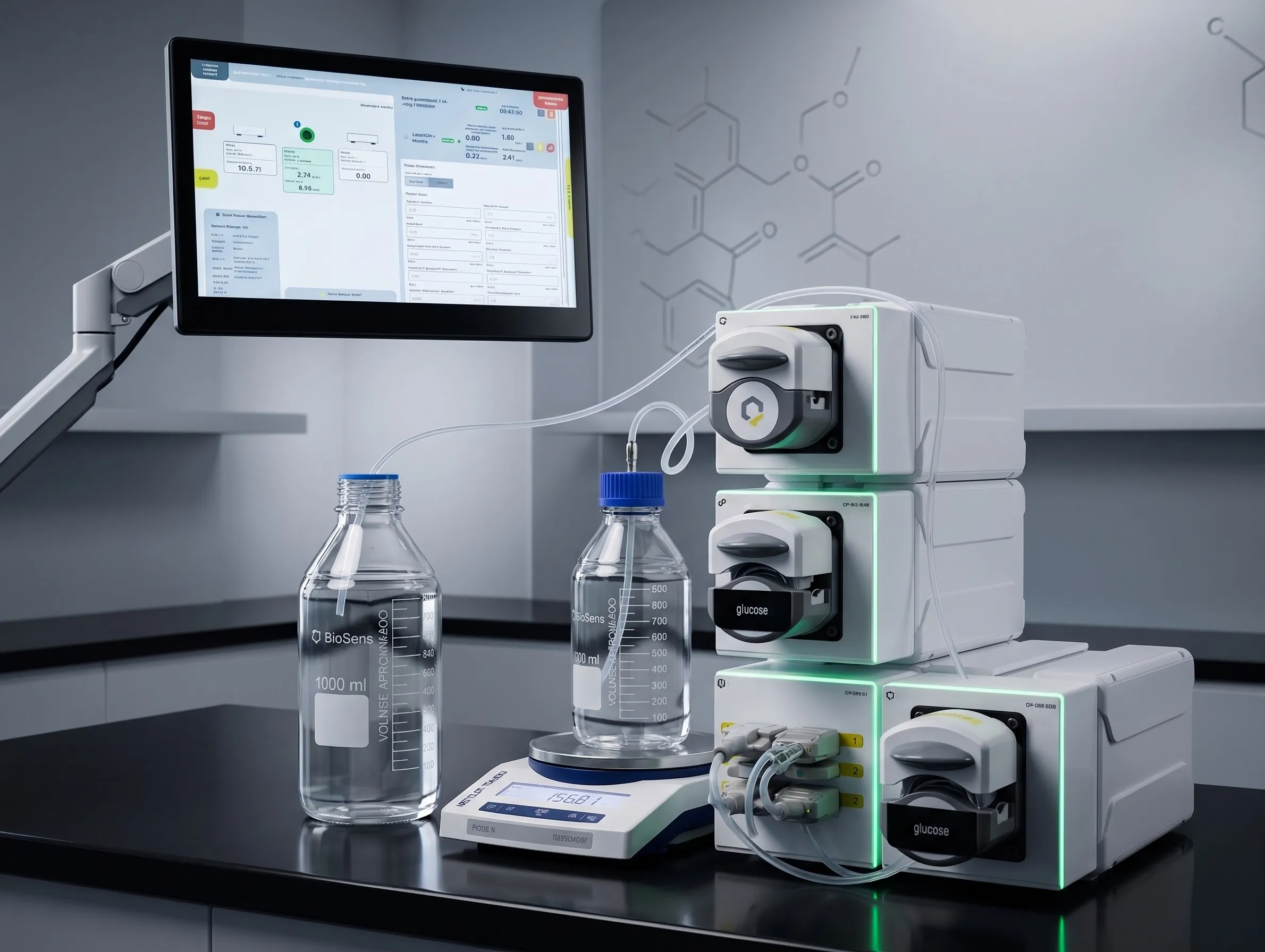
Gravimetric feeding sounds simple — pump liquid off a scale, weigh what’s left, control the flow. In practice, it’s one of the trickiest control problems in bioprocessing. We ran a weekend experiment series to find out exactly where things break.
At 1 g/min with 30% glucose syrup through a flow disturber, peristaltic pump pulsation creates significant instantaneous flow variance — even though the source scale (0.1 g resolution) can measure it precisely. The PID controller sees real physical oscillation, not measurement noise.
What fixed it: “Filter Time Constant” set correctly smoothed the pulsation dynamics into something the PID controller could work with steadily. At higher flows (5+ g/min), pulsation effects diminish relative to the flow rate.
The flow disturber and glucose syrup changed the pump’s response characteristics compared to water. PID tuning had to account for this.
A small integral term eliminated the steady-state error caused by the viscous media and backpressure — without causing windup.
Batch 7 — aggressive PID settings caused the pump to go rogue:
And yet: 199.8 g dispensed against 200 g target. 99.9% cumulative accuracy.
This is the core strength of gravimetric feeding — the scale keeps honest count regardless of what the pump is doing. Cumulative mass accuracy is self-correcting. But pump stress at 7.5x commanded speed isn’t production-acceptable, so we’re now implementing RPM output clamping and sanity checks.
Real processes don’t run at a single flow rate. Perfusion protocols adjust feed based on cell density. Fed-batch processes ramp over days.
All transitions clean. PID reinitialized properly per phase. No cumulative errors carried between runs. 400+ grams dispensed in 55 minutes — through viscous glucose syrup with simulated backpressure.
This is the part that changes the game. The entire test rig incl. hardware connectivity, P&ID, services, recipes — was operational in about an hour. And then all executed… remotely 🙂
No custom code. No PLC programming. No weeks of integration. The complexity lives in the validated service template and software-defined system, not in your project timeline.
Here’s where it gets really interesting. After each batch, we exported the complete process data — mass flow, pump RPM, scale weight, PID parameters, audit trail — directly from QB Control’s Backup & Export module. A few clicks, and we had the full dataset ready for analysis.
We then fed those 4.4 million data points into an AI analytics pipeline that:
The traditional approach: run a batch, manually review trends, adjust one parameter, repeat. For 249 parameter changes, that’s weeks of painstaking review.
Our approach: Run batches → export from Backup & Export → AI analytics → optimized recommendations. What would take days of manual review was done in minutes.
The result: a validated parameter set (Kp=0.8, Ki=0.12, Deadband=0.2) with quantified accuracy expectations for every flow rate — ready to deploy as service defaults.
This is the feedback loop that makes software-defined processing practical: rapid experimentation + instant data export + AI-driven analysis = tuning cycles measured in hours, not weeks.
When setup takes an hour instead of weeks, and PID optimization takes minutes instead of days, you can afford to run 6 experimental batches, deliberately break things, and build a validated knowledge base for your specific fluid and hardware combination.
We tested with 30% glucose syrup and a flow disturber. But every process is different.
We want to hear your real-world gravimetric feeding challenges — fed-batch, perfusion, continuous processing, or anything else involving precision liquid dosing by weight.
Drop a comment or reach out directly. We’re planning the next round of experiments and we’d love to design test scenarios around the problems you’re actually solving.
Let’s make gravimetric feeding boring. In the best possible way.
Related: Building Hardware at Software Speed — AI-assisted hardware engineering of QB Modules, including the AI analytics pipeline behind this tuning.