Article
Lab Automation vs. Self-Driving Labs: Why Integration, Not Robotics, Closes the Loop
By QB Systems · 4 min read
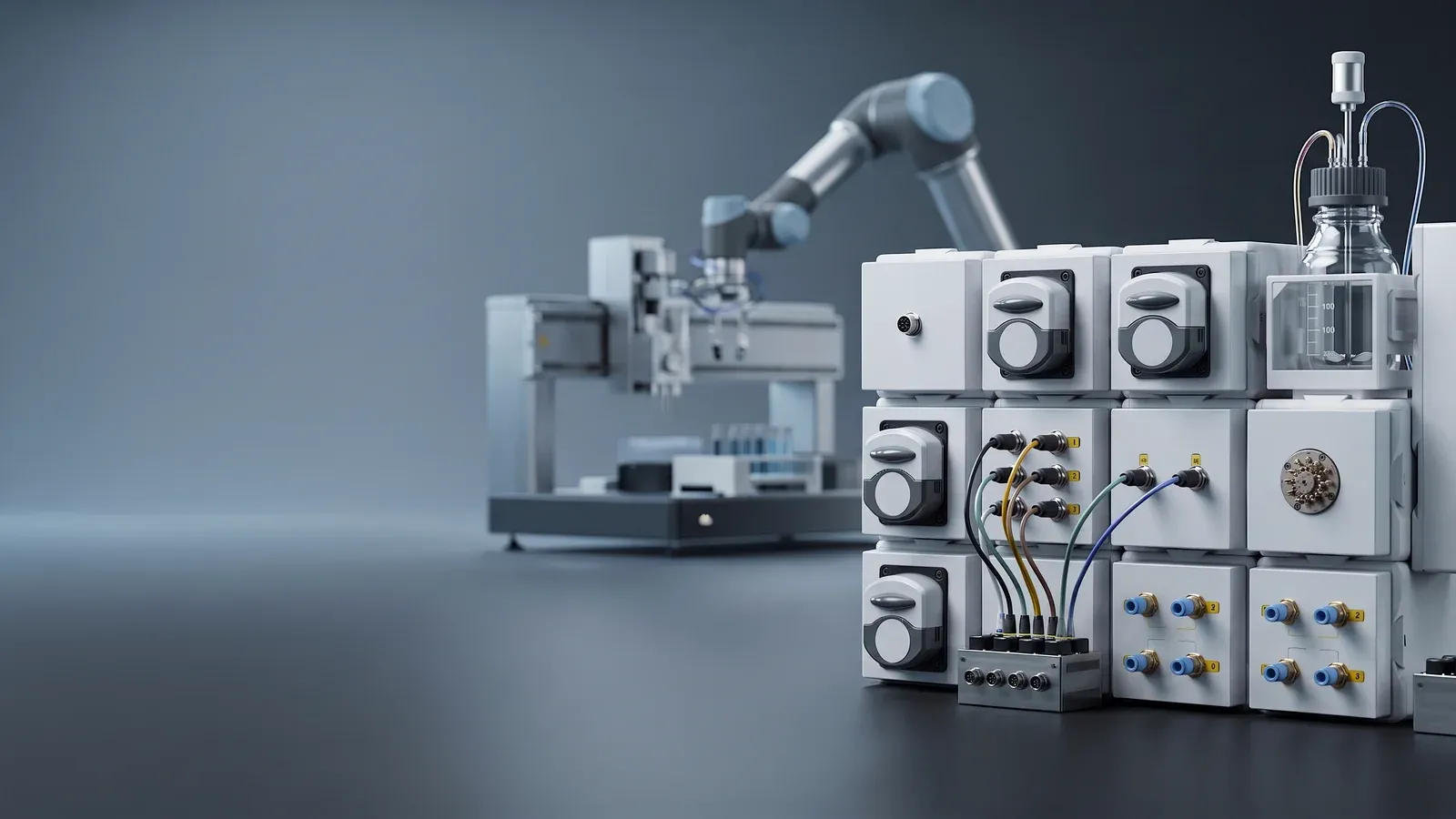
In 2017 Eli Lilly opened an automated remote lab reported at about $90 million. By 2024 it had stepped back from the model and sold the equipment. In 2025, investors put more than a billion dollars into self-driving labs. Before you fund either kind of lab, it is worth being precise about what each one is, and about the part that decides whether it works.
Lab automation and self-driving labs are different categories
“Lab automation” and “self-driving lab” get used interchangeably. They are not the same category at two maturity levels.
Lab automation automates individual steps under human direction: liquid handling, robotic workstations, automated storage and retrieval. It is established technology and standard equipment in most pharma and biotech labs.
A self-driving lab closes the full loop. An AI proposes a hypothesis, directs robots to run the physical experiment, interprets the results and iterates, with little human intervention. It is a much younger category.
| Lab automation | Self-driving lab | |
|---|---|---|
| What it automates | Individual steps under human direction | The full loop: hypothesis, experiment, analysis, next iteration |
| Maturity | Established; standard in most pharma and biotech labs | Early stage |
| Market signal | Roughly $6–9 billion, around 350 vendors (industry estimate) | Over $1 billion of disclosed venture funding in 2025 |
| What makes it work | Reliable instruments and validated protocols | Real-time, calibrated, integrated data from every instrument |
The largest recent raises show where the money is going: Lila Sciences has announced $550 million in total funding, and Periodic Labs a $300 million seed round. The difference between the two categories is not the number of robots. It is whether the loop can close on its own.
What a closed loop needs: real-time, trustworthy instrument data
The throughput numbers make automation look like the whole story. One published comparison reported Emerald Cloud Lab at about 46,620 samples per subscribing lab per year, against roughly 8,880 for a comparable traditional lab: more than five times the throughput.
That figure comes from continuous, unattended operation. Continuous operation only works if every instrument, sensor and result already reaches the control system in real time, in a form it can use.
A closed loop is only as good as the data moving around it. If a reading is late, uncalibrated or trapped in one vendor’s software, the AI decides on bad inputs, the loop breaks and a person steps back in. At that point you have bought expensive robotics and rebuilt a manual lab around them.
What happened to Lilly’s $90 million automated lab
Our reading is that the robotics were never the hard part. The integration and the operating model around them were. That is the precedent underneath today’s funding wave: most teams raising money for autonomous discovery still have to solve the same integration and data problem, one closed instrument island at a time.
Where QB Systems fits: the sensing and integration layer
We build the layer the robots sit on. QB Systems® is modular by design: composable blocks you assemble around the process you already run, rather than a platform you have to rip and replace.
- Calibrated, continuous measurement. QB Multisensor streams readings continuously, so the data driving the loop is trustworthy, not batched and retyped.
- Open, vendor-agnostic integration. QB Control speaks OPC-UA, Modbus and MQTT, and we retrofit existing and third-party hardware instead of asking you to standardize on one vendor. It is compliant with 21 CFR Part 11 and ISA-18.2 from the start.
- One auditable data stream. A single, audit-trailed stream replaces a dozen silos, which is what a process or MSAT team needs before it can trust an automated decision.
None of this is glamorous. It is also the part that decides whether an automation investment compounds or gets sold off. See how it connects to your existing systems on our integrations page.
How to decide between lab automation and a self-driving lab
- If you need throughput and reproducibility, invest in lab automation now. It is proven, and the return is well understood.
- If you are pursuing a fully closed loop, fund the integration and sensing foundation first. Ask for evidence of a working hypothesis-to-result loop before you count autonomy as installed capacity.
- Either way, the foundation is the same: unified, calibrated, auditable data from every instrument.
The takeaway: build the data foundation first
The robots were never the hard part; the layer underneath them is. Automate the steps you can prove out today, and build the sensing and integration foundation that lets a loop close tomorrow. That foundation is what we build. If you are planning either kind of lab, we are happy to look at your setup with you.