Article
The State of Benchtop Automated Sampling in Bioprocessing: A Comparative Analysis for 2026
By QB Systems
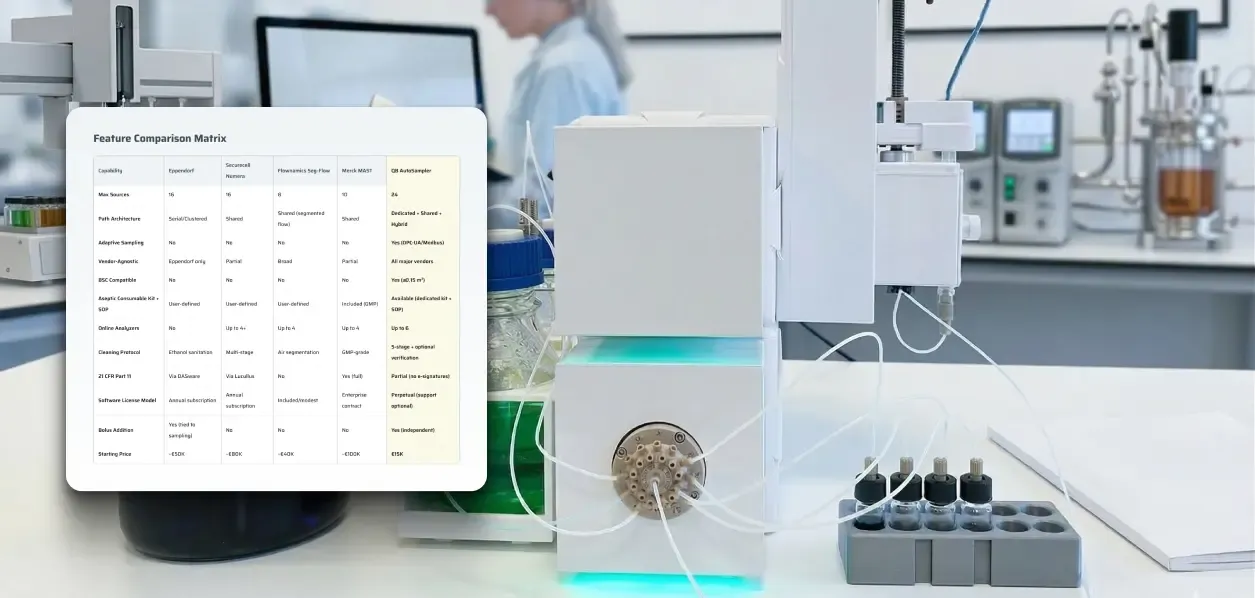
The bioprocess automation market is projected to reach $7.2 billion in 2026, growing at a 12.6% CAGR, with bioprocess analyzers and sampling technologies representing a $2.4 billion sub-segment growing at 10.1% annually. Behind these numbers sits a practical reality: every bioprocess lab running parallel bioreactors faces the same bottleneck.
Manual sampling from even a modest 8-bioreactor setup consumes 80–120 hours of technician time per 14-day fed-batch campaign. That figure includes nights, weekends, and the cognitive load of maintaining aseptic technique at 3 a.m. on a Saturday. When a technician’s hands touch a sampling port, they introduce both a contamination vector and a source of variability. Cross-contamination between parallel reactors in a Design of Experiments study can invalidate weeks of work. Inconsistent sample volumes distort metabolite profiles. And gaps in sampling — the 6-hour window between scheduled manual draws — hide the very process excursions that engineers need to understand.
Automated sampling systems solve these problems, but they solve them differently. The market in 2026 offers a range of approaches: from established incumbents with deep ecosystem integration to newer entrants rethinking the architecture. This analysis examines the major solutions available today, evaluates their respective strengths and trade-offs, and models the total cost of ownership for realistic laboratory scenarios.
The goal is transparency. Every system discussed here has legitimate applications where it excels. The question for any lab is which combination of capabilities, constraints, and economics best fits their specific situation.
Before comparing platforms, it is worth clarifying a distinction that marketing materials often blur: sterile sampling and aseptic sampling are not the same thing.
The baseline expectation for any automated bioreactor sampling system. It means the fluid path, connectors, and sample containers are free of viable microorganisms at the point of use. Most systems achieve this through autoclaving, chemical sterilization, or single-use sterile disposables. Sterile sampling prevents microbial contamination from the sampling system itself.
Goes further. It encompasses the entire workflow discipline — not just sterile components, but validated procedures for maintaining sterility throughout the sampling event, including connection and disconnection of fluid paths, operator technique, environmental controls, and documented standard operating procedures (SOPs). Aseptic sampling is what regulators mean when they reference GMP-compliant sampling: a validated, repeatable process with traceability from the bioreactor to the sample container.
In practice, this means an aseptic sampling capability requires more than sterile hardware. It requires a dedicated aseptic consumable set — pre-sterilized, validated, lot-traceable tubing, connectors, seals, and vials packaged as a single-use kit — paired with a documented SOP that defines each step of the sampling event, from pre-connection verification through sample labeling and storage. Without both elements, a system provides sterile sampling (clean components) but not aseptic sampling (validated process assurance).
Robotic needle-based sampling with septum-sealed ports. A robotic arm moves a syringe-equipped tool to each bioreactor sampling port, pierces the septum, aspirates, then deposits the sample into septum-capped vials.
Eppendorf has the deepest integration within its own bioreactor ecosystem. The Bioprocess Autosampler connects seamlessly with DASbox (up to 16 mini bioreactors), DASGIP (up to 16 parallel vessels), SciVario twin (up to 8), and BioFlo 320 (up to 4). Software control lives inside DASware control 6, meaning a single interface manages bioreactors and sampling simultaneously. Sterile airflow around each needle tip provides contamination protection. Eppendorf has published extensive application data, including a May 2025 study demonstrating monoclonal antibody stability across extended automated sampling campaigns. The system provides sterile sampling as standard.
The system is designed exclusively for Eppendorf bioreactors. Labs running mixed-vendor equipment — which is the norm in many process development environments — cannot use the Eppendorf autosampler for their Sartorius, INFORS HT, or Applikon vessels. The septum-piercing mechanism places a physical limit on total sampling events per port before septum integrity degrades. Aseptic sampling with validated SOPs and dedicated consumable kits would need to be defined by the end user. The system’s footprint is not designed for operation inside a Biosafety Cabinet (BSC).
DASware control 6 software is required and carries an annual license fee (estimated €5,000–€10,000/year). This is a subscription model — if the license lapses, software features may become restricted. The licensing cost is incremental to the hardware investment and compounds significantly over a 5-year ownership period.
Labs fully committed to the Eppendorf bioreactor ecosystem, particularly those running DASbox or DASGIP for high-throughput process development within a single vendor’s hardware.
€50,000–€120,000 depending on configuration and bioreactor count, plus annual software licensing.
Modular flow-based sampling with integrated dilution, filtration, and analyzer routing. The system consists of a Control Module, Routing Module, and stackable Multiplexer Modules, with optional Dilution and Filtration Modules for in-line sample preparation.
Numera is arguably the most sophisticated sample preparation system on the market. Its tape-filtration technology provides cell-free samples for biochemical analyzers without centrifugation, and the integrated dilution module achieves precision ≤2% SD at ratios up to 1:20. Up to four Multiplexer Modules can be stacked, connecting 16 bioreactors to multiple analyzers simultaneously. Combined with Securecell’s Lucullus SCADA software, it becomes a comprehensive bioprocess data platform. Securecell has also launched the Integra1-64 for true high-throughput applications at production scale. The platform provides sterile sampling through its closed fluid-path design.
The system’s strength — integrated sample preparation — also defines its complexity. The multi-module architecture (Control + Routing + Multiplexers + optional Dilution + optional Filtration) means a significant footprint and a steeper learning curve for installation and maintenance. Numera is primarily oriented toward online analyzer feeding rather than standalone vial-based sample archival. The multi-module footprint makes BSC placement impractical. Pricing reflects the sophistication: complete systems with all modules represent a substantial capital investment.
Lucullus SCADA software carries an annual license fee (estimated €8,000–€16,000/year depending on module count and feature tier). Lucullus is central to the system’s value proposition — it provides SCADA, data management, and process control. The recurring cost is significant but delivers genuine ongoing value through software updates and expanded analytics. However, for labs that only need basic sampling without advanced SCADA, the license represents overhead.
Mid-to-large-scale bioprocess development labs and CDMOs that need tight integration between sampling and online analytics (HPLC, cell counters, metabolite analyzers), and have the budget and technical staff to fully leverage the platform.
€80,000–€200,000 depending on module configuration, plus annual Lucullus licensing.
Segmented-flow sampling using air-liquid segmentation to transport samples through shared tubing to analyzers or fraction collectors. The patented approach uses air plugs to isolate each sample segment, reducing cross-contamination in shared fluid paths.
Flownamics’ segmented-flow approach is elegant in its simplicity. By using air as a physical barrier between sample segments, the system achieves low carryover without requiring dedicated tubing per bioreactor. The Seg-Flow S3 supports 8 vessels with delivery to up to 4 analyzers simultaneously, with optional Sample-Mod S3 for in-line dilutions (up to 1:20). The Seg-Flow PS targets cell and gene therapy applications with a compact, modular design that sits near the bioreactor. FlowWeb software provides OPC-compatible data export to SCADA systems. A strategic partnership with Beckman Coulter integrates the Vi-CELL BLU cell counter for automated cell viability analysis. Sterile sampling is achieved through the closed segmented-flow architecture.
The Seg-Flow platform is primarily an online sampling system — it excels at feeding analyzers but does not emphasize temperature-controlled vial archival in the way Eppendorf does. The 8-vessel limit per system is adequate for many labs but constraining for high-throughput screening. While the segmented-flow approach reduces carryover effectively, labs running GMP processes or contamination-sensitive cell cultures may prefer truly dedicated fluid paths. The system is not designed for BSC-internal operation.
FlowWeb software is typically included with the hardware purchase or carries a modest one-time license fee. This is one of Flownamics’ competitive advantages — lower ongoing software costs compared to subscription-based competitors. Some advanced features or updates may require service agreements, but the base software model is more favorable for long-term TCO.
Labs focused on continuous online monitoring with at-line analyzers, particularly those already using or planning to use Beckman Coulter Vi-CELL BLU. Also suitable for PAT (Process Analytical Technology) implementations where real-time analyzer data is the primary objective.
€40,000–€100,000 depending on model and analyzer integration, with FlowWeb software typically included.
Modular automated aseptic sampling designed for GMP-ready environments. Originally developed by Lonza and acquired by Merck in 2022, the MAST platform uses Sample Pilot modules — the SP100 for stainless-steel bioreactors (SIP-compatible) and SP200 for single-use and development-scale vessels.
MAST carries the strongest regulatory pedigree. Built for pharmaceutical manufacturing environments from the ground up, it addresses GMP requirements natively — including aseptic sampling with validated processes. The system connects up to 10 bioreactors to four primary analyzers per unit. Its modality-agnostic design handles upstream processing, downstream processing, and microbial fermentation alike. Merck’s acquisition brought the platform into a broader portfolio that includes process development tools, filtration, and chromatography — creating potential for integrated workflow solutions. The SP200’s compatibility with single-use technology aligns with the market’s single-use momentum (44.9% of the bioprocess automation market, growing at 16% CAGR).
MAST is built for manufacturing-scale thinking. This translates to higher complexity and cost compared to benchtop-focused alternatives. The 10-bioreactor limit per unit is lower than competitors. The system’s footprint is designed for manufacturing suites, not benchtop or BSC environments. The system is optimized for the pharmaceutical GMP context, which means labs in early-stage R&D or academic settings may be paying for regulatory infrastructure they do not yet need. Pricing is at the premium end of the market, reflecting the GMP-grade design and Merck’s enterprise positioning.
MAST software and service agreements are enterprise-grade, with annual costs for software maintenance, support, and validation services. Pricing is typically bundled into service contracts that include on-site support, calibration, and software updates. The enterprise approach aligns with pharmaceutical procurement models but represents significant recurring cost. Exact annual fees are negotiated per installation.
Pharmaceutical manufacturing sites, late-stage process development, and GMP environments where regulatory compliance, single-use compatibility, and integration with Merck’s broader bioprocessing portfolio are priorities.
€100,000–€300,000 depending on configuration, with additional annual service agreement costs.
A sterile sampling probe system using needle-free connectors with autoclavable components. The LEDA is a compact, per-bioreactor sampling device rather than a centralized multi-bioreactor system.
LEDA provides up to 180 sterile samplings per batch at very low cost per bioreactor. The fully autoclavable design (121–133°C, 30 minutes) means no chemical sterilization between batches. Syringe options (3, 5, or 10 mL) provide volume flexibility. The needle-free connector eliminates septum degradation over repeated samplings. As a per-bioreactor accessory, it integrates naturally into Solaris Jupiter and Saturn bioreactor setups.
LEDA is a semi-automated sampling aid rather than a fully automated system. It does not provide scheduled, unattended sampling or analyzer integration. A technician still initiates each sampling event. It is limited to Solaris bioreactors. There is no software-controlled scheduling, adaptive sampling, or data logging beyond what the bioreactor controller provides. No BSC-compatible form factor.
No software license required. The LEDA is a hardware-only accessory with no recurring software costs. Replacement consumables (septa, connectors) are the only ongoing expense.
Solaris bioreactor users who want to improve sampling sterility and consistency without investing in a full automation platform. Suitable for labs where a technician is present during sampling but needs better aseptic technique assurance.
Typically under €5,000 per bioreactor — an order of magnitude less than centralized systems, but with proportionally reduced capability.
A programmable fraction collector that can be coupled with a peristaltic pump for time-based or event-triggered automated sample collection from bioreactors.
The Omnicoll offers exceptional timing flexibility, with sampling intervals from 0.1 minutes to 166 hours. When paired with a multichannel peristaltic pump, it can sample from multiple bioreactors simultaneously. Event-triggered sampling based on fermentation alarm signals is supported. The system is vendor-agnostic — it works with any bioreactor that has a sample port. Cost-effective relative to the dedicated bioprocess autosampling platforms.